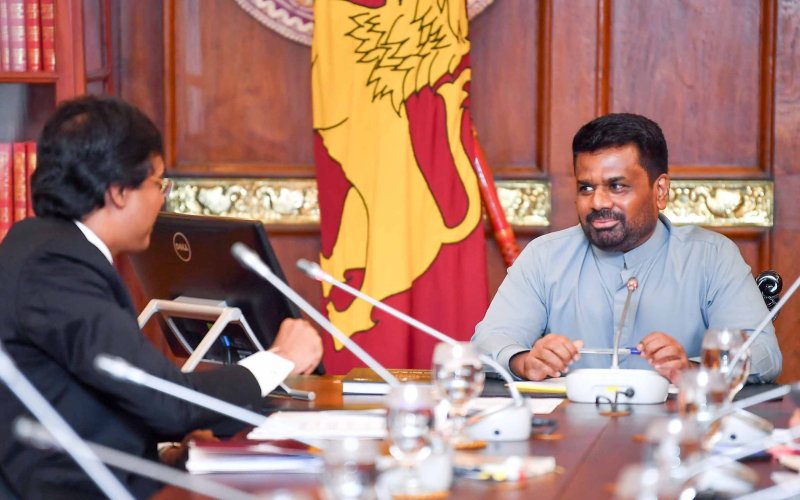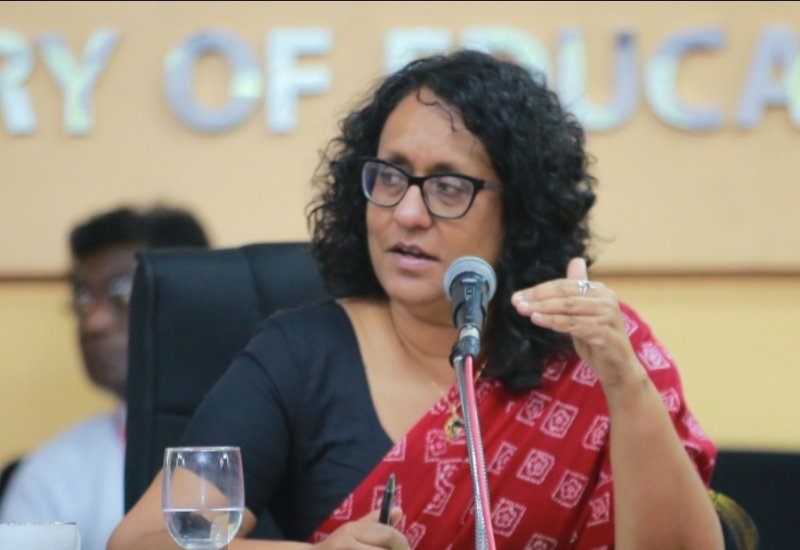
Prime Minister and Minister of Education, Higher Education and Vocational Education Dr. Harini Amarasuriya said today that decades-long problems in Sri Lanka’s education sector stem from inequality between schools, which has created serious challenges in the teaching and learning process.
Prime Minister and Minister of Education, Higher Education and Vocational Education Dr. Harini Amarasuriya said today that decades-long problems in Sri Lanka’s education sector stem from inequality between schools, which has created serious challenges in the teaching and learning process.
Addressing a ceremony at the Ministry of Education, Dr. Amarasuriya said the pressures faced by students, teachers, and principals in the competitive education system are all linked to disparities between schools. “Minimizing this inequality is a primary objective of education reform,” she stated, adding that the focus should be on improving the quality of the learning-teaching process rather than the prestige of the school.
The Prime Minister emphasized that the direct participation, leadership, and example set by principals and teachers are fundamental to enhancing educational quality.
She highlighted that the current education reform focuses not only on syllabus changes but also on human resource development, administrative improvements, equitable distribution of infrastructure, and digitalization of the learning process.
“The education reform will be carried out in a planned and systematic manner,” she said, noting that weaknesses in the system will be identified, updated, and addressed. The plan includes laying a solid foundation over the next three years, followed by formal administrative reforms, infrastructure development, and digital modernization.
Special efforts are being made to improve classroom facilities and limit class sizes, with primary classes capped at 40 students and secondary classes at 45, to enhance the quality of learning experiences.
Dr. Amarasuriya added that the goal is to transform schools into centers of quality learning and meaningful experiences for children, rather than institutions solely focused on examinations. She also emphasized that parental and citizen involvement is crucial to the success of these reforms and called for a collective national effort despite the challenges.