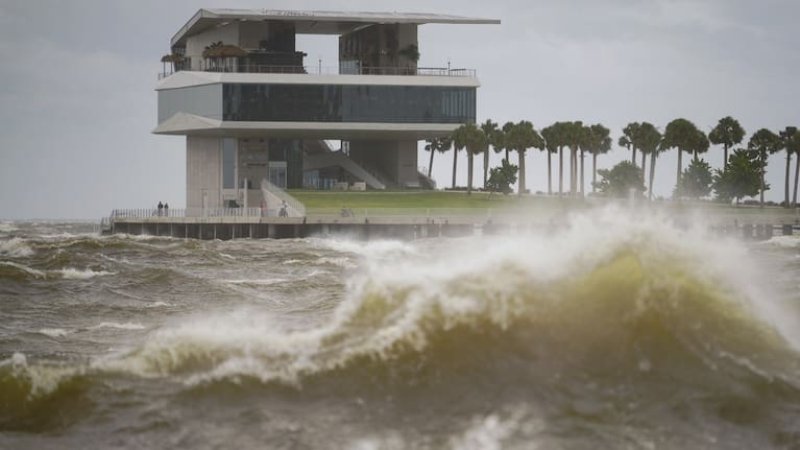
A powerful hurricane was barreling towards Florida on Thursday, with officials warning of "unsurvivable" conditions and a potentially catastrophic storm surge high enough to swamp a two-story house.
Tens of thousands of people were without power and roads were already flooded ahead of what is expected to be one of the largest Gulf of Mexico storms in decades.
It was packing winds of 130 miles (215 kilometers) per hour as it churned over the Gulf's warm waters towards the Big Bend area south of Florida's capital city TallahEVERYONE along the Florida Big Bend coast is at risk of potentially catastrophic storm surge," the NHC said on social media.
Tampa and Tallahassee airports have closed, with parts of St. Petersburg, downtown Tampa, Sarasota, Treasure Island and other cities on Florida's west coast already flooded.
About 125,000 homes and businesses were without power.
"We're expecting to see a storm surge inundation of 15 to 20 feet above ground level," NHC director Mike Brennan said. "That's up to the top of a second story building. Again, a really unsurvivable scenario is going to play out here in this portion of the Florida coastline."
The accompanying waves "can destroy houses, move cars, and that water level is going to rise very quickly," Brennan added.
- Evacuate or hunker down? -
In Alligator Point, a coastal town on a picturesque peninsula in the storm's path, David Wesolowski was taking no chances.
"I just came to button up a few things before it gets too windy," the 37-year-old real estate agent told AFP as he boarded up his house on stilts.
"If it stays on course, this is going to look different afterwards, that's for sure," he said, before taking his family to higher ground in Tallahassee.
Meanwhile, Patrick Riickert refused to budge from his small wooden house in Crawfordville, a town of 5,000 people a few miles inland.
National Weather Service said the region could be hit extremely hard, with floods not seen in more than a century.
"This will be one of the most significant weather events to happen in the western portions of the area in the modern era," it warned.
Tornado warnings went out across northern Florida, Georgia and the Carolinas.
Georgia's sprawling capital Atlanta was forecast to experience tropical storm-force winds and flash flooding from up to 12 inches of rain.
Researchers say climate change likely plays a role in the rapid intensification of hurricanes, because there is more energy in warmer oceans for them to feed on.