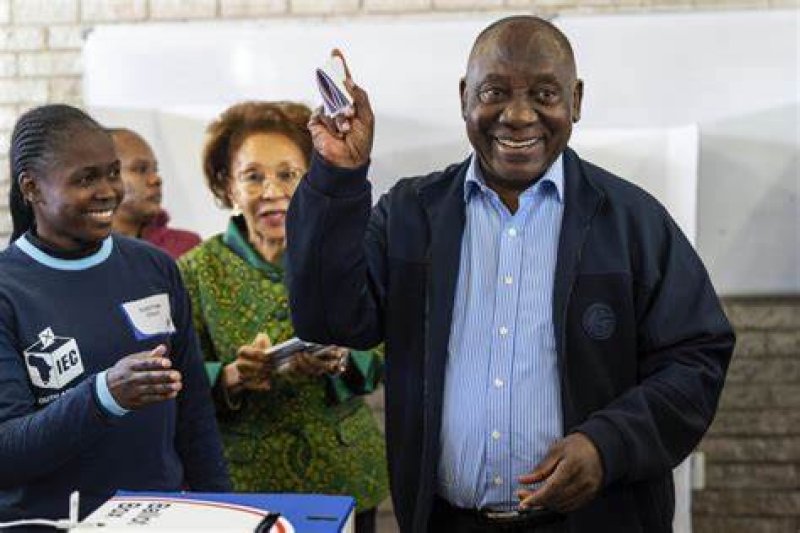
For three decades, power in South Africa has had a three-letter name: the ANC, or the African National Congress. The political party once led by Nelson Mandela has been a powerful symbol of liberation from white minority rule, attracting loyalty from millions of South Africans who remember life under apartheid.
But after winning election after election for 30 years, the ANC led by President Cyril Ramaphosa is now facing its biggest challenge since taking power in 1994, potentially marking a watershed moment for one of Africa’s most powerful nations and a major test for South Africa's still-fledgling democracy.
Polling ahead of Wednesday’s election shows that for the first time, the ANC could fall below 50% of the vote. Although the party would still likely end up ultimately controlling the presidency, it would be forced to enter into a coalition with smaller parties who blame the ANC’s current direction for the nation’s profound problems.
“It’s a huge election in that respect,” said Christopher Vandome, senior research fellow with the Chatham House’s Africa Programme. “A lot of opposition is seeing that this is perhaps the first opportunity that they’ve had for 30 years for a more pluralistic politics.”
Here, NBC News takes a look at what could be a pivotal election.
In the years after apartheid ended with the first free, democratic election in 1994, many voters credited the ANC with improving life for South Africans — especially for the Black majority that gained basic rights. International sanctions that had hampered the economy went away, and the gross domestic product surged.
“People felt like things were getting better,” Vandome said. “For the last 10 to 15 years, that’s plateaued, and so there has been a real rise in frustration with the government.”
It’s easy to see why. An unemployment rate hovering around 32% — the world’s highest — has plagued South Africa’s economy and hit younger workers especially hard. Income inequality, especially between whites and Black people, is persistent; Two years ago, the World Bank ranked South Africa as the most unequal country in the world.
Moreover, an energy crisis has triggered rolling blackouts across the nation that have hampered businesses. And many voters have said they blame the ANC and its successive governments for failing to rein in runaway violent crime rates and corruption.
Then there’s the issue of race, still a painful, omnipresent backdrop to South Africa’s politics.
“We haven’t really transcended the issue of race as a country,” said Hlengiwe Ndlovu, senior lecturer at Johannesburg’s Wits School of Governance. “And this continues to play itself out, especially when young people are looking at the opposition parties and trying to decide which political party can actually represent their interests.”
The Democratic Alliance, the second-biggest vote-getter in the last election in 2019, is campaigning on a platform of rescuing South Africa from widespread corruption and fixing the economy. Urging people to vote the ANC out to “rescue” the country, party leader John Steenhuisen has called it “South Africa’s most consequential election in post-democratic history.”
Yet, the party has also struggled with the perception among many that it’s largely the party of white voters.
Another challenge to the ANC comes from the Economic Freedom Fighters, formed about a decade ago. Its core base includes young people, including many Black university students concerned about racial inequality. Polling at around 11% before Wednesday’s election, its leader Julius Malema has criticized the ANC’s platform for being not nearly ambitious enough.
Among the newcomers to the scene is uMkhonto weSizwe, or “spear of the nation,” also known as the MK party. Named after the ANC’s former paramilitary wing, it was formed last year by former South African President Jacob Zuma, as a breakaway party from the ANC.
Although the Supreme Court has ruled that Zuma cannot himself run for office because of a previous criminal conviction for contempt of court, his face will appear on the ballot next to his party.
In South Africa’s democracy of more than 60 million people, voters don’t vote directly for president, but instead select which party they want to represent them in the parliament, known as the National Assembly. The 400 members of the National Assembly then choose the president.
If there’s no outright majority, the highest vote-getter — likely the ANC — would be forced to negotiate with one or more smaller parties to form a coalition that would put them over 50% of seats. NBC