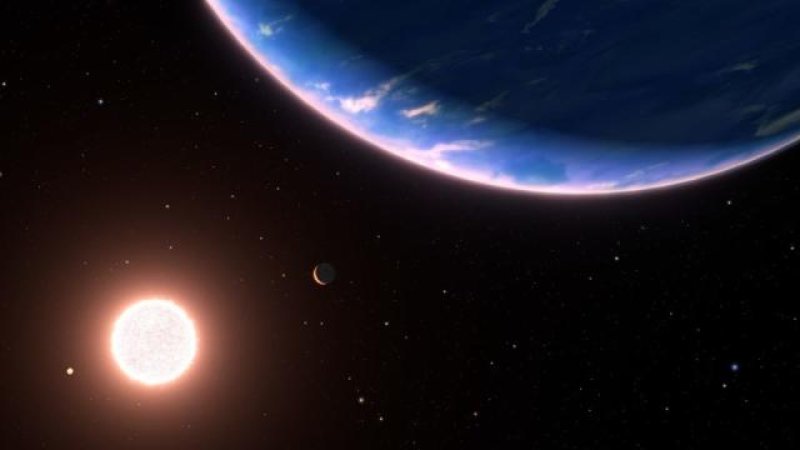
Astronomers using the Hubble Space Telescope have detected water molecules in the atmosphere of a small, blazing-hot exoplanet 97 light-years from Earth.
The planet, named GJ 9827d, is about twice Earth’s diameter, and it’s the smallest exoplanet found to have water vapor in its atmosphere, according to a new study.
Water is essential for life as we know it, but the planet is unlikely to host any type of life due to searing temperatures that would turn a water-rich atmosphere into scorching steam.
The astronomers have yet to uncover the true nature of this unusual world’s atmosphere, but the revelation paves the way for further investigation as they seek to understand the origins of planets beyond our solar system.
The findings appeared in a report published Thursday in The Astrophysical Journal Letters.
Water on a planet this small is a landmark discovery,” said study coauthor Laura Kreidberg, managing director of the atmospheric physics of exoplanets department at the Max Planck Institute for Astronomy in Heidelberg,
Astronomers using the Hubble Space Telescope have detected water molecules in the atmosphere of a small, blazing-hot exoplanet 97 light-years from Earth.
The planet, named GJ 9827d, is about twice Earth’s diameter, and it’s the smallest exoplanet found to have water vapor in its atmosphere, according to a new study.
Water is essential for life as we know it, but the planet is unlikely to host any type of life due to searing temperatures that would turn a water-rich atmosphere into scorching steam.
The astronomers have yet to uncover the true nature of this unusual world’s atmosphere, but the revelation paves the way for further investigation as they seek to understand the origins of planets beyond our solar system.
The findings appeared in a report published Thursday in The Astrophysical Journal Letters.
“This would be the first time that we can directly show through an atmospheric detection, that these planets with water-rich atmospheres can actually exist around other stars,” said study coauthor Björn Benneke, professor at the University of Montreal’s Trottier Institute for Research on Exoplanets, in a statement. “This is an important step toward determining the prevalence and diversity of atmospheres on rocky planets.”
Currently, the research team can’t tell whether Hubble picked up on water vapor traces within a puffy, hydrogen-rich atmosphere or the planet has a water-rich atmosphere because the host star evaporated GJ 9827d’s original hydrogen and helium atmosphere.
the planet orbiting a red dwarf star in the Pisces constellation in 2017. The exoplanet completes a single orbit around its host star every 6.2 days.
Astronomers observed GJ 9827d during 11 transits, or times when the planet crossed in front of its star during orbit, over three years. Starlight filtering through the planet’s atmosphere helped astronomers measure.
CNN