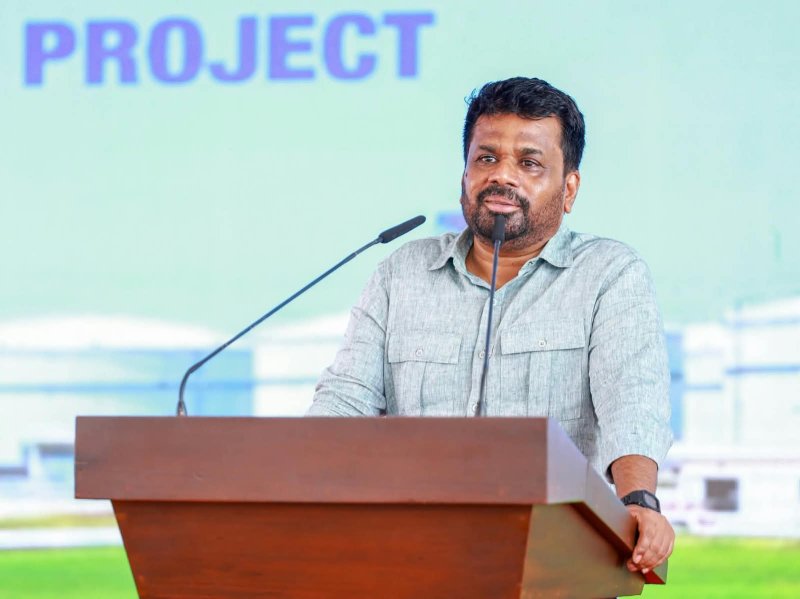
Following is the full speech delivered by President Anura Kumara Dissanayake this morning (02) while attending the commencement of construction of the Jet A-1 pipeline system of the Ceylon Petroleum Corporation (CPC) and two new oil storage tank systems belonging to the CPC and the Ceylon Petroleum Storage Terminal Limited (CPSTL):
“Our energy sector needs a very good, advanced and well-planned agenda. However, if we look back at the past, there was not much public confidence in the energy sector and state institutions. The three institutions, the Ceylon Petroleum Corporation (CPC), the Ceylon Electricity Board (CEB) and SriLankan Airlines, had become a significant burden on our economy.
In particular, when we look at the Ceylon Petroleum Corporation, it had accumulated a debt of Rs. 840 billion. The impact of this debt on the state banking system was so significant that even state banks were placed in a highly vulnerable position.
As a result, a strong view began to emerge in society that these state institutions should be sold and privatised. There was also a growing view that the Government could no longer manage these institutions and that they should be relinquished. By the time we came into office, even the refinery of the Ceylon Petroleum Corporation had been separated and was being prepared for divestment.
However, we must clearly understand that although our country’s energy market is very small, we are of the view that the Government must retain a leading share of the energy sector for the functioning of the country’s economy and social life.
But, this position can be justified to society, and the people can be convinced of the need for state intervention, only if the efficiency of these institutions is improved and they provide the services expected by the people properly.
It is the responsibility of these institutions to achieve a very high level of efficiency. At present, it is evident that our Chairman, Board of Directors, senior management and employees at all levels are working towards achieving a very high level of efficiency.
In the past, these institutions had become heavily politicised. Political platforms were created through these institutions, and after governments came to power, groups were even deployed from these institutions to attack others.
However, during the nearly two years since we came into power, we have completely stopped the practice of filling institutions with new employees based on political requirements. For the projects currently under way, we have recruited only a few essential employees, including four engineers and around 10 employees on a contractual basis at the airport to implement the Jet A-1 fuel project.
Unlike in the past, we have completely stopped filling these institutions with employees based on the requirements of ministers’ electorates. We are running these institutions scientifically and free from political interference.
What we want is to maintain a strong state presence in the energy market while providing an efficient service to the people. If we look back at the balance sheet of the past two years in achieving this objective, we have been successful.
We remember that the private sector was brought into the fuel market with the intention of creating competition for CPC. It was believed that having competitors in the market would improve CPC’s efficiency.
However, what has happened today is that other institutions cannot sell at the prices set by CPC. Previously, CPC had a share of around 58% of the diesel market. Last month, CPC’s market share increased to 74%.
Why has this happened? Private suppliers have been unable to compete at the prices set by CPC. As a result, they have significantly reduced their fuel supplies.
Although CPC has been selling at a lower price, it has increased its profits. This means that CPC has become the most successful competitor in the market.
If the entire oil market were in our hands, we could have developed an even more efficient system. Profits and losses are calculated at the end of the year. We could adjust prices and provide a better service, but we do not currently have that ability because the private sector holds a certain share of the market.
Despite all these challenges, CPC recorded a profit of Rs. 36 billion last year, while CPSTL recorded a profit of Rs. 3.5 billion. So far this year, CPC has recorded a profit of Rs. 28 billion.
Therefore, institutions that previously operated on bank loans have now been able to maintain a substantial positive financial position. As a system of institutions, we have therefore developed to the level we expected.
Our next major challenge is ensuring national energy security. Based on the existing storage capacity, we currently have sufficient fuel for only around 23 to 25 days. This can create uncertainty regarding a country’s energy security.
Therefore, we have begun projects to expand pipeline systems, reduce unloading times and establish tank systems with a capacity of 100,000 cubic metres, in order to maintain storage capacity for at least 45 days, or one and a half months. Accordingly, we have now commenced a tank system with a capacity of 104,000 cubic metres.
The next major issue is how we can provide this energy to the people at the lowest possible price. Our economy is now resilient to internally generated conditions.
In the past, the Treasury was operating with bank overdrafts of between Rs. 500 billion and Rs. 700 billion. However, by the end of last year, we were able to maintain a positive surplus of Rs. 1.2 trillion in the Treasury account.
Even at present, we maintain a positive surplus of between Rs. 500 billion and Rs. 700 billion, giving us the capacity to withstand internal economic movements and shocks.
However, the major question we face is how to deal with external economic shocks. We cannot control them. The sector most affected by such shocks is fuel supply.
When the war in the Middle East began on 28 February, the energy sector came under significant threat. People became frightened and began queuing for fuel, while some even claimed that electricity cuts would be imposed in July.
On the contrary, state institutions including CPC and CEB worked around the clock to ensure the continuous supply of electricity and fuel. We have now moved beyond the threat to ensuring an uninterrupted energy supply.
The issue we now face is pricing. The price of a barrel of refined diesel in the world market increased from US$80 to US$170, an increase of 91%, while the price of petrol increased from US$70 to US$136, an increase of 80%.
There has been a significant impact on global fuel prices within a short period. We decided not to place the entire burden on the people, but to share the cost among the people, suppliers and the Treasury.
Accordingly, the Treasury provided a fuel subsidy of Rs. 60 billion for five months from April. Under this arrangement, the Treasury bore a cost of Rs. 100 per litre of diesel and Rs. 20 per litre of petrol.
Again, following the increase in global prices in mid-September, the price of diesel should have been increased by Rs. 80 on 1 October. However, we increased it by only Rs. 10, with the Treasury bearing the remaining Rs. 70.
Accordingly, the Treasury has allocated a subsidy of Rs. 41 billion for October, November and December. If the Government instructs CPC to sell below cost in accordance with the pricing formula, the Government must bear that cost.
Therefore, CPC and CPSTL should under no circumstances sell fuel to the market below their cost. The Government must bear the difference. That is our policy.
However, your responsibility is to determine how you can provide the service below cost. There are a number of other important economic instruments connected with the Petroleum Corporation.
We earn additional foreign exchange by supplying fuel to ships and aircraft. So far this year, we have earned US$384 million from supplying fuel to aircraft alone.
Plans are under way to commence an US$800 million new project in November to increase the existing passenger capacity at Katunayake Airport from 11 million to a further 10 million passengers.
Today, we laid the foundation stone for the project to supply fuel through a direct pipeline system instead of bowsers.
Under the existing general subsidy system, an unfair situation has arisen in which wealthy people who own large vehicles that consume more fuel receive a greater subsidy.
Therefore, next week we will hold discussions with the Ministry of Digital Economy to develop a new digital mechanism for providing fuel subsidies targeting only sectors with genuine needs, such as public transport, agricultural machinery, fishing vessels and lorries transporting vegetables.
We expect to develop a new digital mechanism to provide the existing general subsidy scheme exclusively to sectors with genuine needs, such as public transport, agricultural machinery, fishing vessels and lorries transporting vegetables.
I express my gratitude to the Chairman, Board of Directors, management and all employees who have dedicated themselves to this effort, and invite everyone to work together to build a successful energy market.”