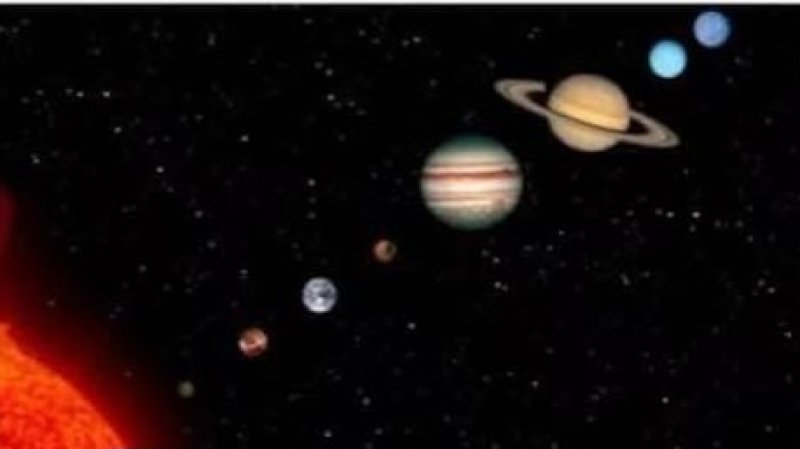
Sri Lanka is set to witness two major celestial events this week, with six planets expected to form an arc across the sky before sunrise tomorrow (12), while the Perseid meteor shower reaches its peak during the same period.
According to the Astronomy Division of the Arthur C. Clarke Institute for Modern Technologies, Mercury, Mars, Jupiter, Saturn, Uranus and Neptune will appear across the eastern and southern sky in what astronomers commonly call a “planet parade.”
Four of the six planets will be visible to the naked eye, while binoculars will be needed to spot Uranus and a telescope will be required to observe Neptune.
The best time to view the planetary alignment will be around 60 to 90 minutes before sunrise, between approximately 4.30 a.m. and 5.15 a.m., looking from the eastern horizon towards the south.
Mars and Saturn are expected to be relatively easy to identify. However, Mercury and Jupiter will appear low on the eastern horizon and may be difficult to observe as sunrise approaches.
The institute said Sri Lanka’s location close to the equator provides favourable conditions for observing the planetary alignment.
Meanwhile, the Perseid meteor shower is also expected to reach its peak from the night of August 12 to the early hours of August 13.
The Perseids are produced by debris from Comet 109P/Swift-Tuttle, which was discovered in 1862 and takes approximately 133 years to orbit the Sun. The meteors appear to originate from the direction of the Perseus constellation.
This year, the peak of the meteor shower is expected to coincide with a new moon, creating darker skies and potentially favourable viewing conditions. Under clear skies, observers could see up to 100 meteors per hour.
For the best chance of seeing the Perseids, observers are advised to look towards the northeastern sky after midnight on August 12 and into August 13. Allowing 20 to 30 minutes for the eyes to adjust to the darkness is also recommended.