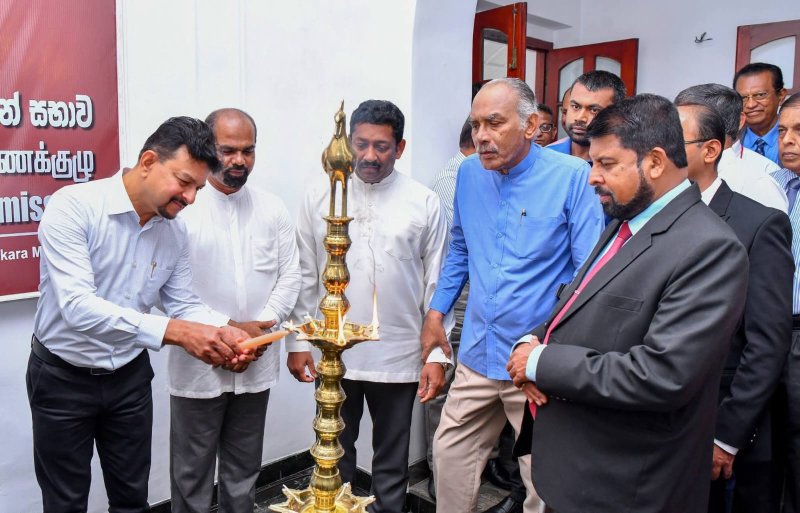

The Public Officers' Salaries and Pensions Commission officially commenced operations today (4) at its office on Malalasekara Mawatha, Colombo 7, under the patronage of the Minister of Public Administration, Provincial Councils and Local Government, Professor Chandana Abeyratne. PMD rwported.
The Commission was established following a proposal presented by President Anura Kumara Dissanayake in the 2026 Budget. Its establishment was formally gazetted through Extraordinary Gazette No. 2494/05, dated 22 June 2026.
The 15-member Commission is chaired by former Ministry Secretary Ashoka Peiris, while Nalaka Disanayake serves as its Secretary.
The Commission has been entrusted with recommending solutions to longstanding issues relating to the salaries and pensions of public officers, enhancing professionalism within the public service, and advising on the structural reforms required to modernise the public service in line with emerging technologies and global trends.
The inaugural ceremony commenced with multi-faith religious observances. Addressing the gathering, Minister Professor Chandana Abeyratne said that a commission had not been established to address public sector salary issues for more than two decades, while this was the first time in Sri Lanka's history that a dedicated commission had been appointed to examine pension-related issues affecting retired public officers.
The Minister stressed that strengthening the public service was essential to the country's development, as public officers play a critical role in national progress. He noted that resolving longstanding issues within the public service was therefore of paramount importance.
He further observed that although salary and pension issues had been discussed for many years, no comprehensive and scientific framework had previously been introduced to address them.
Professor Abeyratne explained that attempts to resolve issues affecting one segment of the public service in isolation had often resulted in unintended consequences for employees in other sectors. He said the President's objective was to introduce a comprehensive, evidence-based framework that would address the needs of the public service as a whole, expressing confidence that the Commission fully understood the significance of this responsibility.
The Minister also stated that successive governments had failed to resolve longstanding issues, including salary anomalies within the public service, largely due to a lack of genuine commitment. He added that the present Government, led by President Anura Kumara Dissanayake, possessed both the determination and the dedicated team required to address these longstanding concerns.
Speaking further, the Minister said:
"All members appointed to this Commission possess extensive experience in the public service, including several retired senior public officers who have firsthand knowledge of these issues. I am confident they will approach this task with a clear understanding and a strong sense of purpose.
In the first Budget presented after assuming office, the President proposed a salary increase for all public servants pending the resolution of salary anomalies. The increase is being implemented in three stages over a three-year period, beginning on 1 January 2025, with the final phase taking effect on 1 January 2027. These salary revisions will also apply to all public officers who retired on or after 1 January 2025. Accordingly, a public officer who retired on that date will receive a pension calculated on the basis of the revised salary applicable from 1 January 2027.
These salary increases were introduced both in recognition of the dedication and commitment shown by the overwhelming majority of public servants and in acknowledgement of the genuine difficulties they face. Although a small minority may fail to fulfil their responsibilities, most public officers serve with professionalism and commitment. Their dedication was clearly demonstrated during the recent disaster, Ditwah cyclone.
The President has also instructed all public institutions to identify and submit their actual requirements without being constrained by expenditure considerations. Through these measures, the President and the Government aims to strengthen the public service and deliver a more efficient and citizen-centred public administration.
Recruitment to the public service had been suspended since 2020. However, after assuming office, the Cabinet approved the recruitment of 120,000 new public servants, and that process is now under way."
Deputy Minister of Labour Mahinda Jayasinghe also addressed the gathering. He noted that salary anomalies within the public service had been the subject of discussion for many years and recalled that, as a trade union representative, he had previously submitted proposals and concerns to earlier salary commissions, but no satisfactory solutions had been implemented.
He expressed confidence that the new Commission would adopt a comprehensive and scientific approach to addressing these issues, rather than resolving them on a piecemeal basis.
The Deputy Minister further pointed out that the Commission's mandate extended beyond addressing salary anomalies to include recommending measures to enhance the professionalism of the public service.
He also noted that official residences previously used by ministers for personal accommodation had now been repurposed for public service, adding that the Commission itself had been established in a former ministerial official residence.
From today (4), a two-month period will be open for trade unions, professional organisations and members of the public to submit their views, concerns and proposals to the Public Officers' Salaries and Pensions Commission. A trilingual public notice outlining the submission process will be published in newspapers this Friday.
Commission Chairman Ashoka Peiris and Commission Secretary Nalaka Disanayake also addressed the gathering.
Among those present were Deputy Minister of Public Administration, Provincial Councils and Local Government Ruwan Senarathna, Member of Parliament Chandana Sooriyarachchi, public officials, trade union leaders and representatives, and several other invitees.