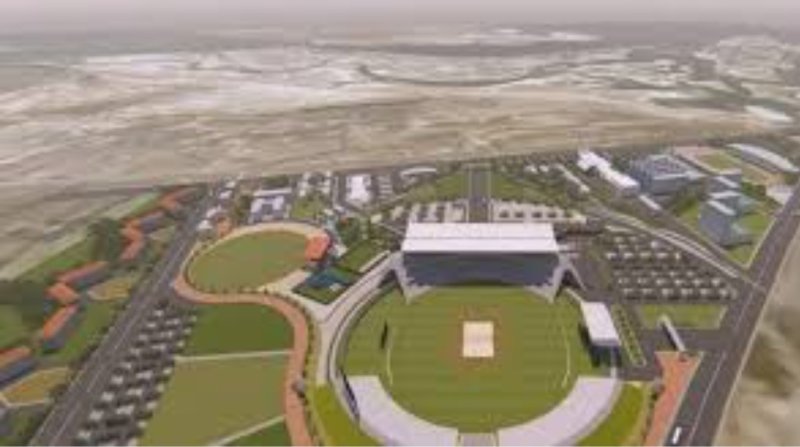
The project, launched last year with the foundation stone laid by President Anura Kumara Dissanayake, is being developed on Mandaitivu Island in Jaffna.
Chairman of the Central Environmental Authority, Professor Tilak Hewawasam, said construction activities have been ordered to stop until the required environmental clearance is obtained.
He stated that the necessary approval to conduct an EIA has now been granted, but the assessment must be completed and submitted to the Central Environmental Authority within a maximum period of two years. Only after the report is reviewed and approved will permission be given to resume construction.
Work on the stadium commenced on 1 September 2025 under the patronage of the President. At the time, President Dissanayake expressed confidence that the first match could be played by the end of last year and that an international fixture could be hosted within three years.
Environmental activist Sajeeva Chamikara pointed out that the land selected for the construction of the international cricket stadium on Mandaitivu Island is a sensitive wetland ecosystem, and warned that the project would result in its destruction.
In a statement issued on 23 February under his signature, he alleged that Sri Lanka Cricket has already begun illegally filling the wetland system and fencing off the area without obtaining environmental approval.
The statement further notes that plans under the project include not only an international cricket stadium but also a golf course, residential units and a hotel complex, forming a large sports city. He warned that this would lead to the complete destruction of the wetland system and the collapse of the small-scale fishing industry in the Jaffna lagoon.
Chamikara explained that Mandaitivu Island comprises a wetland system made up of mangroves, salt marshes and freshwater marshes, which serve as feeding grounds for large populations of resident and migratory wetland bird species.
He also cited research identifying migratory birds from wetlands across the world that use the Jaffna wetland system.
In addition, he warned that as the Jaffna lagoon is a breeding ground for fish, prawns and crabs, the project could severely impact the livelihoods and economy of small-scale fishing communities.
Chamikara noted that in 2014, under funding from United Nations development and environmental programmes, there had been proposals to declare the Jaffna lagoon a protected sanctuary. He expressed suspicion that long-standing plans to destroy the wetland system may be the reason such a declaration has not yet been made.
The statement emphasises that filling more than 10 acres of wetland land for a development project requires prior written approval following an Environmental Impact Assessment process, and that failure to do so constitutes a punishable offence under the law. It further notes that filling more than two hectares of wetland also requires an archaeological impact assessment and approval.
He alleged that Sri Lanka Cricket is forcibly implementing the project without any of these approvals, apparently under pressure from the President and the Minister of Sports, warning that this sets a dangerous precedent for future development projects.
Chamikara stressed that international sports facilities should be established only after feasibility studies, at locations that do not harm the environment or people’s livelihoods, and with proper environmental approvals to ensure public benefit.
“Having experienced how the environment, economy and people’s lives have been devastated by flawed planning under previous governments, we expected a systematic, realistic and people-centred development process from the present administration,” he concluded.