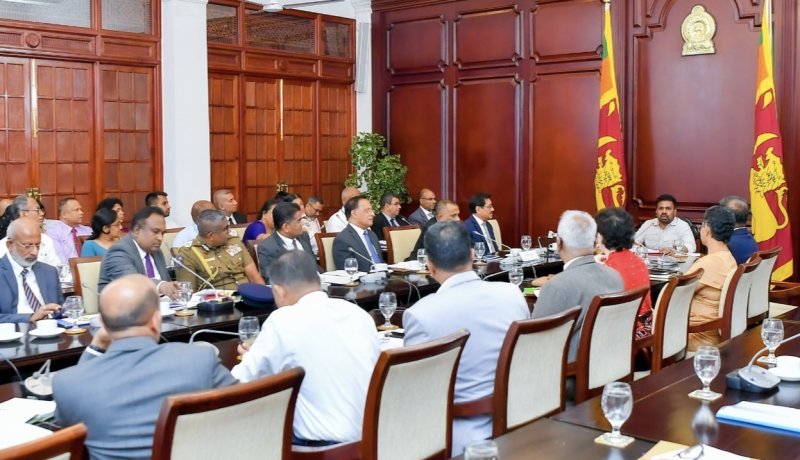
Sri Lanka has stepped up preparations for its Third Mutual Evaluation on Anti-Money Laundering and Combating the Financing of Terrorism (AML/CFT), with a high-level discussion held this morning at the Presidential Secretariat under the patronage of President Anura Kumara Dissanayake.
Addressing officials, the President emphasized that before demonstrating integrity to the international community, the government must first take responsibility for its own actions and commit to good governance. He called on all stakeholders to properly and responsibly discharge their institutional duties to ensure the success of the evaluation process.
International AML/CFT standards are set by the Financial Action Task Force (FATF), which has issued 40 recommendations that member countries are required to follow. These recommendations form the basis of an in-depth assessment of a country’s legal framework, institutional capacity, resource allocation, and the effectiveness of measures in preventing money laundering, terrorist financing and the financing of the proliferation of weapons of mass destruction. This comprehensive assessment process is known as the Mutual Evaluation.
Sri Lanka’s evaluation is overseen by the Asia/Pacific Group on Money Laundering (APG), with advisory support from former APG Executive Secretary Dr. Gordon Hook. Domestically, around 25 government institutions are involved, with coordination led by the Financial Intelligence Unit of the Central Bank of Sri Lanka. Progress is monitored by the Presidential Operational Committee on AML/CFT.
The discussion reviewed Sri Lanka’s previous Mutual Evaluations in 2006 and 2014–2015, including shortcomings that resulted in the country being greylisted internationally in 2017. Participants underscored the importance of prioritizing the current programme at the national level, noting the government’s strong political leadership aimed at restoring and strengthening Sri Lanka’s international credibility.
President Dissanayake also inquired into legal bottlenecks and delays in enacting required legislation and instructed officials to expedite necessary technical amendments. Concerns were raised over human resource shortages in several institutions, which have hindered progress. The President directed that immediate steps be taken to address staffing gaps, including exploring the re-employment of experienced retired officers on one-year contracts.
He further instructed corrective measures to address situations where single officers hold multiple positions and ordered that promotions and recruitments be fast-tracked in consultation with the Public Service Commission. To avoid disruptions caused by frequent staff rotations, the President directed that a circular be issued to retain trained officers in their current roles until the evaluation concludes in November.
The report of the Presidential Special Task Force monitoring the evaluation process is expected to be submitted within the next two weeks.
The meeting was attended by Minister of Justice and National Integration Harshana Nanayakkara, Central Bank Governor Dr. Nandalal Weerasinghe, Secretary to the Ministry of Finance, Planning and Economic Development Dr. Harshana Suriyapperuma, Secretary to the Ministry of Defence Air Vice Marshal Sampath Thuyacontha (Retd), Secretary to the Ministry of Foreign Affairs Aruni Ranaraja, Attorney General Pärinda Ranasinghe, Inspector General of Police Priyantha Weerasuriya, Chief of National Intelligence Major General Nalinda Niyangoda, and heads of several key institutions.