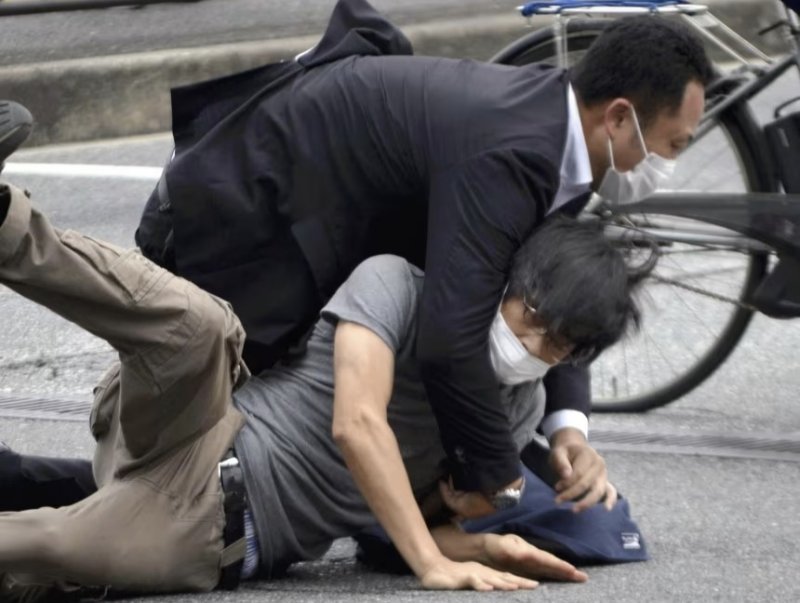
The man who killed Japan’s ex-Prime Minister Shinzo Abe with a homemade gun was sentenced to life in prison on Wednesday, public broadcaster NHK reported.
The ruling concludes a yearslong trial over an assassination that shocked Japan – where gun violence is rare – and put the spotlight on an influential religious sect.
Tetsuya Yamagami shot Abe in broad daylight with a gun he fashioned at home, while the former leader was giving a campaign speech on a street in the western city of Nara in 2022.
Abe had stepped down as prime minister in 2020 over health reasons. But he was still politically active and wielded enormous influence as Japan’s longest-serving premier.
Yamagami, now 45, was arrested at the scene and indicted the following year on murder and firearms charges.
Hundreds queued up outside the court in Nara for a chance to witness proceedings, with officials resorting to a lottery to assign limited seats.
Abe, whose premiership is seen as Japan’s last period of political stability, held office from 2006 to 2007 and again from 2012 to 2020. During his two terms, he transformed Japan’s security posture, raising questions over its status as a pacifist nation, and passed major security legislation in 2015 that expanded what Japan could do militarily to support the United States.
He also was a prominent figure on the world stage, cultivating strong ties with Washington and seeking better relations with Beijing – while also trying to counter Chinese expansion in the region by uniting Pacific allies.
His killing sent shock waves through Japan, which has one of the world’s lowest rates of gun crime due to its strict firearms laws.
Since his resignation the national political landscape has been in disarray, with a revolving door of different leaders. Abe’s Liberal Democratic Party, which has ruled Japan almost continuously for the last 30 years, became mired in crisis – facing fallouts over a slush fund scandal, an inflation surge and a rightward political shift across the country.
The current prime minister, Abe’s protege Sanae Takaichi, has called snap polls next month to capitalize on her rising popularity while hoping to rebuild the LDP brand.
The killing also brought scrutiny to the link between the LDP and the Unification Church. Yamagami blames the sect for bankrupting his family through excessive donations from his mother, a member. He had claimed he targeted Abe because he believed the former leader was associated with the church, which originated in South Korea.