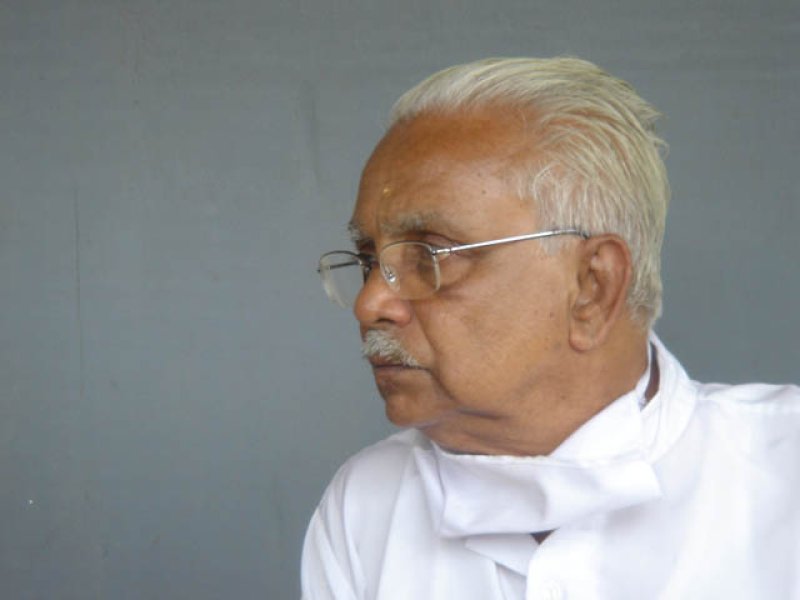
A.T. Ariyaratne was born on 5 November 1931 in Unawatuna village in Galle District of Ceylon. He had his school education at Buona Vista College, Unawatuna and Mahinda College, Galle
Dr. AT Ariyaratne, the founder of Sarvodaya, has passed away.
. Then he attended a teachers college, after which he was a high school teacher until 1972 at Nalanda College Colombo. Ariyaratne started his work on Sarvodaya Shramadana Movement in 1958. He earned a Bachelor of Arts degree in economics from Vidyodaya University of Sri Lanka and later received an honorary doctorate of D.Litt. from the same university. He also received an honorary doctorate of humanities from Emilio Aguinaldo College in the Philippines. Ariyaratne is a devout Buddhist and continues to be active in Sri Lankan politics and community development.
He received the Ramon Magsaysay Award for Community Leadership in 1969, the Gandhi Peace Prize from the government of India in 1996, the Niwano Peace Prize in 1992, the King Beaudoin Award and other international honours for his work in peace making and village development. In 2006, he received the Acharya Sushil Kumar International Peace Award for the year 2005. Other recipients of this award include John Polanyi and then in 2004, the 14th Dalai Lama. In 2007 Ariyaratne received the Sri Lankabhimanya, the highest National Honour of Sri Lanka.
Dr Ariyaratne, a strong believer in Gandhian principles of non-violence, rural development and self-sacrifice, has shaped the Sarvodaya Movement in ways that forged a significant link between secular principles of development and Buddhist ideals of selflessness and compassion. As a devout Buddhist, he has led tens of thousands of "family gatherings" and meditations with millions of people throughout Sri Lanka and other parts of the world. When he received the Hubert H. Humphrey International Humanitarian Award from the University of Minnesota's Hubert H. Humphrey School of Public Affairs in 1994, Dr. Patrick Mendis described his former mentor as the "Gandhi of Sri Lanka."[4] He passed away on 16 April, 2024 at a private hospital in Colombo, Sri Lanka.
He is married to Neetha, and has six children- Vinya, Charika, Jeevan, Sadee, Diyath, Nimna. He also has 12 grandchildren - Janatha Marasinghe, Damni Marasinghe, Hasala Ariyaratne, Aseni Ariyaratne, Jithvan Ariyaratne, Kanishtaa Ariyaratne, Tiara Ganegama, Sanara De Silva, Liana Ariyaratne, Niven Ganegama, Sanchit De Silva, Diyana Ariyaratne.[5]
such as poverty, disease, oppression, and disunity in their environment.Ariyaratne argues that these things are types of sufferings that occur throughout Sri Lanka and the rest of the world. It is important for all people to recognise that these sufferings exist and they should be addressed by those who have the ability to help with the suffering on both an individual level as well as with the community as a whole.
The Second Noble Truth is the origin of suffering which means one needs to understand where the suffering throughout the world is coming from. Ariyaratne reinterprets this to mean "the decadent condition of the village has one or more causes. Sarvodaya teaches that the causes lie in factors such as egoism, competition, greed, and hatred."[13] These causes point to the things that the Sarvodaya Shramadana Movement is trying to overcome with its programs on both an individual level and for the community as a whole. Ariyaratne feels that egoism, competition, greed, and hatred cause much of the suffering in the world and should be combated and can be combated by social action programs such as the ones formed by the Sarvodaya Shramadana Movement. They need to be removed from the individual person so that these qualities are no longer one's own qualities.
The Third Noble Truth is cessation, or the end of suffering, which means that one needs to understand that suffering can be ended through achieving Nirvana. The Sarvodaya Shramadana Movement reinterprets this to mean "the villagers' suffering can cease." Ariyaratne feels that since one's personal sufferings can end with this Buddhist concept the sufferings of each individual villagers' suffering can also end through the help of other people. The Sarvodaya Shramadana Movement seeks to do this by helping villagers rebuild their lives and form a strong community bond that is based on helping one another.
The Fourth Noble Truth means that the end of this suffering can be attained by Eightfold Path to Nirvana. The Eightfold Path includes right view, right intention, right speech, right action, right livelihood, right effort, right mindfulness, and right concentration. Ariyaratne reinterprets this to mean that each part of the Eightfold Path can be applied to the restoration of the people. For example, in the case of right mindfulness, Sarvodaya Shramadana interprets this to mean that one needs to "stay open and alert to the needs of the village."This means that if one sees something that needs to be done throughout the community such as with bathrooms, water, or roads then one should attend to those needs. Doing so will help each person in the community and help relieve some form of their suffering.