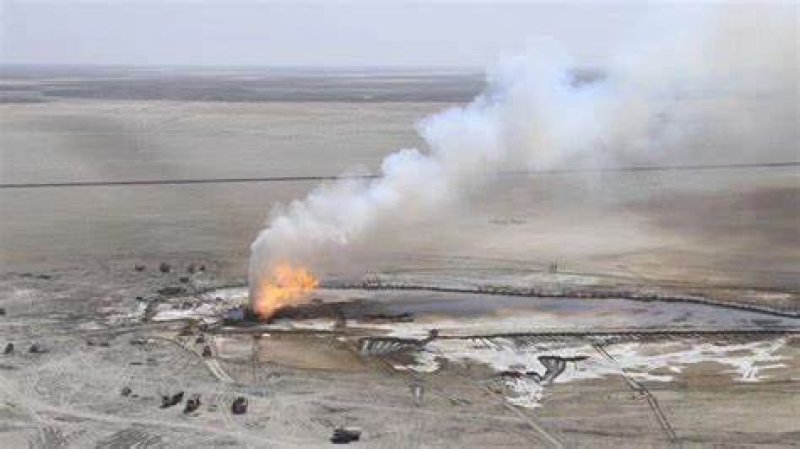
One of the worst methane leaks ever recorded took place last year at a remote well in Kazakhstan, new analysis shared with BBC Verify has shown. It is estimated that 127,000 tonnes of the gas escaped when a blowout started a fire that raged for over six months.Methane is much more potent a greenhouse gas than carbon dioxide.
Buzachi Neft, the company that owns the well, denies a "substantial amount" of methane was leaked.
According to the US Environmental Protection Agency's Greenhouse Gas Equivalency Calculator, the environmental impact of such a leak is comparable to that of driving more than 717,000 petrol cars for a year.
"The magnitude and the duration of the leak is frankly unusual," said Manfredi Caltagirone, head of the UN's International Methane Emissions Observatory. "It is extremely big."
The leak began on 9 June 2023, when a blowout was reported during drilling at an exploration well in the Mangistau region, southwestern Kazakhstan, starting a fire that raged continuously until the end of the year.
It was only brought under control on 25 December 2023. Local authorities told the BBC work is currently being carried out to seal the well with cement.
Natural gas is primarily made of methane, a gas that is transparent to the human eye.
But, when sunlight passes through a cloud of methane, it creates a unique fingerprint that some satellites are able to track.
This particular methane leak was first investigated by the French geoanalytics firm Kayrros. Their analysis has now been verified by the Netherlands Institute for Space Research and the Polytechnic University of Valencia, in Spain.
Looking at the satellite data, scientists found high concentrations of methane were visible on 115 separate occasions between June and December.
Based on those readings, Tthey concluded that 127,000 tonnes of methane escaped from this single well.
Luis Guanter from the Polytechnic University of Valencia, who helped verify the leak, says "only the Nord Stream sabotage may have led to a stronger leak".
In September 2022, underwater blasts tore apart two pipelines carrying Russian gas to Germany - Nord Stream 1 and 2 - releasing up to 230,000 tonnes of methane into the atmosphere.
According to the International Energy Agency, methane is responsible for about 30% of the rise in global temperatures since the Industrial Revolution.
While satellite readings can be affected by external factors such as cloud cover, scientists say they are "completely sure" that vast amounts of methane escaped from this individual well.
"We detected methane plumes from five different methane-sensitive satellite instruments," said Mr Guanter. "Each of these instruments measures methane in a particular way, but we obtained very consistent measurements from all of them."
In a statement, the Department of Ecology in the Mangistau region confirmed that the concentration of methane in the air exceeded legal limits on 10 separate occasions between 9 June and 21 September.
It also said that, in the hours that followed the initial blowout, methane levels in the air were 50 times higher than allowed.
But Buzachi Neft, the Kazakhstani company that owns the well, denies suggestions that vast amounts of methane were leaked.
The company says its well only contained a "negligible" amount of gas, and that any methane leaked would have burnt as it came out of the borehole.
It says it also believes only water vapour was leaked into the atmosphere, forming large white plumes that were visible from space.
"We have approached the situation responsibly," the company's deputy director for strategic development, Daniyar Duisembayev, told the BBC.
An official probe into the causes of the accident - led by Atyrau's Industrial Safety Committee - found that Buzachi Neft failed to appropriately supervise the drilling of the well.
It also blamed Zaman Energo, a subcontractor, for numerous failures in the drilling process. Zaman Energo declined to comment on this story.
In a statement, Kazakhstan's Ministry of Energy told the BBC tackling the leak was a "complex technical operation" and that "there is no universal solution to eliminate similar accidents".
And yet, it is not the first time major methane leaks have been detected in Central Asia.
Like neighbouring Turkmenistan, Kazakhstan has registered dozens of "super-emitter" events - a phrase used by scientists to describe incidents where large amounts of methane are released into the atmosphere.
But Mr Guanter says the event observed in the Mangistau region stands out. "It is the largest methane leak from 'normal' human activities that we have ever detected," he said.
Climate experts at Climate Action Tracker say that, with a projected increase in natural gas production, Kazakhstan faces risks of further methane leakages from gas pipelines.
At last year's COP28 climate summit, Kazakhstan joined the Global Methane Pledge - a voluntary agreement by more than 150 countries to slash their methane emissions by 30 percent by 2030.
Source: BBC