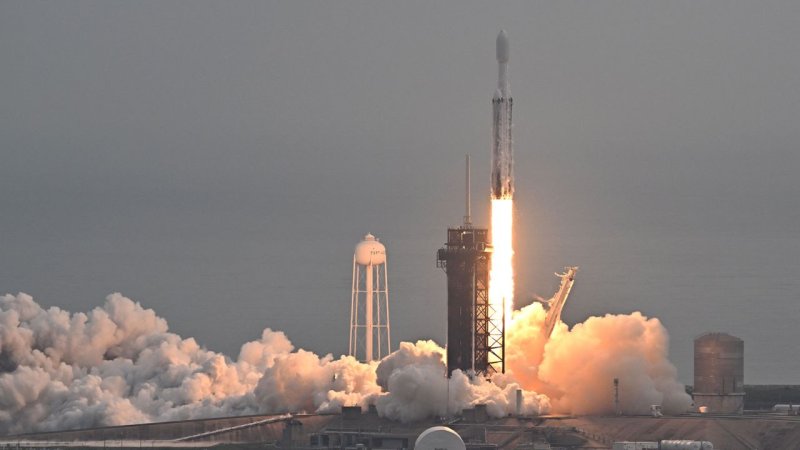
NASA has launched its first mission to a mysterious world made largely of metal, on a journey to find out whether the asteroid is the exposed core of an early planetary building block from the beginning of the solar system.
The Psyche mission lifted off at 10:19 a.m. ET Friday aboard a SpaceX Falcon Heavy rocket from NASA’s Kennedy Space Center in Florida. Psyche will be the first of many upcoming NASA science missions slated to launch aboard the Falcon Heavy rocket
upcoming NASA science missions slated to launch aboard the Falcon Heavy rocket.
The mission, named for the 16 Psyche asteroid it will observe, will travel about 2.2 billion miles (3.6 billion kilometers) over the next six years to reach the space rock, located in the outer part of the main asteroid belt between the orbits of Mars and Jupiter, said David Oh, Psyche chief engineer for operations at NASA’s Jet Propulsion Laboratory in Pasadena, California.
“We’re launching a mission to an object that humankind has never before studied up close,” said Lindy Elkins-Tanton, Psyche principal investigator and foundation and regents professor at Arizona State University’s School of Earth and Space Exploration. “This will be our first time visiting a world that has a metal surface. There aren’t that many completely unexplored types of worlds in our solar system for us to go see, so that is what is so exciting about this.”
Scientists believe the large M-type, or metallic, asteroid could be the exposed core of an early planetary building block and may resemble the cores of rocky planets in our solar system, such as Earth, Mars, Venus and Mercury. The core may have been exposed due to violent collisions with other rocky bodies early in the solar system’s formation.
Ground and space-based telescopes have observed Psyche in the past, mainly detecting radiation bouncing off the reflective metal on the asteroid’s surface. Together, these observations have helped scientists develop a model of the asteroid’s shape, which is about the size of Massachusetts without Cape Cod, and a surface area equivalent to California, Elkins-Tanton said.
But even using the Hubble Space Telescope, Psyche only appears as a few pixels.