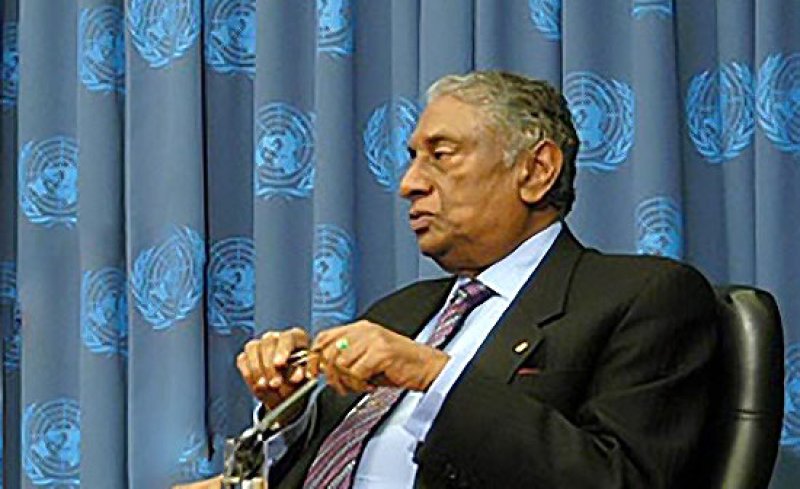
Fifteen years ago, the assassination of Lakshman Kadirgamar on August 12 bought to the fore the perennial discourse on the ‘Sri Lankan identity’. He was a Tamil, but he was also the greatest proponent of a singular Sri Lankan identity.
Lakshman Kadirgamar was born on 12 April 1932 and was educated at Trinity College, Kandy. Kadirgamar graduated from Peradeniya University in 1953 with an LLB (Hons) degree.
He entered Law College in 1954 and passed out as an Advocate. He was admitted to the Bar in 1955. Thereafter Lakshman proceeded to the UK for studies at Oxford University where he distinguished himself as President of the Oxford Union. He returned to Sri Lanka in 1960.
Initially, Lakshman toyed with the idea of embarking on a political career. But his elder brothers in Colombo, Sam JC Kadirgamar, the lawyer, and Rajanathan (Rajan) Kadirgamar, the Naval Commander, advised him to drop his political ambition and concentrate on law.
Their father SJC (Snr) had established a lucrative practice in Colombo and was also the Founder President of the Ceylon Legal Society.
Lakshman heeded the advice of his brothers and began building up a legal practice. There are some of Lakshman’s relatives who believe that he would have never entered politics had his two elder brothers been alive.
Both Rajan and Sam had passed away before Lakshman entered active politics in 1994.
Lakshman Kadirgamar returned with his family to the UK in 1971 after the 1971 JVP insurgency. He lived abroad for 17 years and returned home to Sri Lanka again in 1988.
“I have had a privileged life by birth, by education, by access to opportunities, and I have always felt that a time must come when you must give something back to the society in which you have grown up and from which you have taken so much. So-called educated people must not shirk responsibilities in public life. I have reached that stage in life when, without being heroic about it, I feel I should participate more fully in public life.”
I am prompted by the recent news about the removal of ‘race’ from the Sri Lankan birth certificate to dwell briefly on this topic. Indeed, whether the mention of race is removed or not, Lakshman Kadirgamar would have been delighted that the issue, which remains a hindrance to achieving a true oneness, is being debated and perhaps is even inching closer to an acceptable solution. Of his many comments on the topic of identity, this is the one for which he will forever be remembered
Lakshman Kadirgamar’s progressive thinking on matters of race and ethnicity were the result of a lifetime of study, deep reflection, endless discourse and global travel; he was far ahead of his time, yet was shackled by petty politics and divisive thinking. He had to contend with the narrow thought process of a section of the majority community who assumed that being a Tamil, he was against them, while at the other end of the spectrum, a section of the Tamil community felt that he had betrayed them. Neither understood that he was espousing an all-inclusive Sri Lankan identity that would result in an overarching sense of pride and belonging for all citizens of Sri Lanka.
The tragedy of Lakshman Kadirgamar’s premature death is that he was unable to transcribe his thoughts, theories and practical experience in issues of national identity, foreign policy and international relations into a comprehensive manifesto. Had he lived longer he would surely have written copiously on these matters close to his heart and perhaps these writings would have become the blueprint for a reinvented Sri Lanka.