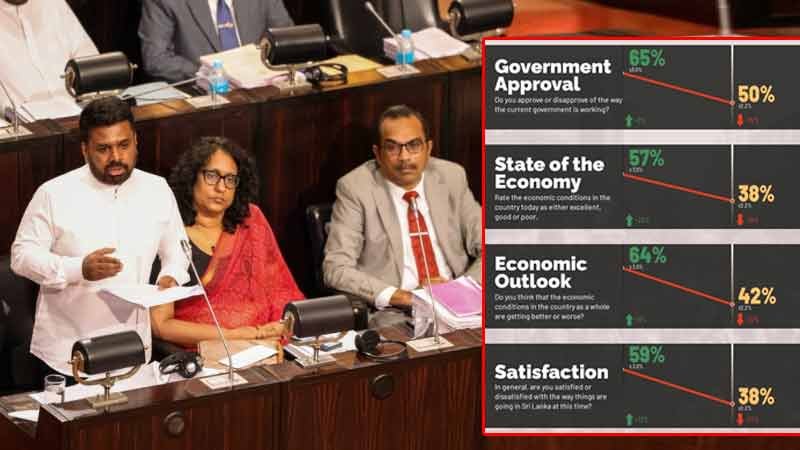
Sri Lankan government approval has fallen to around 50%, while public confidence in the country’s economic outlook has weakened sharply, according to the latest “Mood of the Nation” poll conducted by Verité Research.
The July 2026 survey found that 49.83% of respondents approved of the way the current government was working, compared with 31.40% who disapproved. This marks a notable decline from the 65% approval recorded in the previous round conducted in February, when public sentiment toward both the government and the economy was significantly more positive.
Economic sentiment also weakened considerably. The proportion of Sri Lankans who believed economic conditions were “getting better” fell to 41.63%, down from 64% in February. At the same time, 40.29% said conditions were “getting worse”, indicating a much narrower gap between positive and negative perceptions of the economy.
Public assessment of current economic conditions was similarly subdued. Some 55.59% of respondents rated the economy as “poor”, while only 38% described conditions as either “good” or “excellent”. This represents a significant shift from February, when the share describing economic conditions as good or excellent had, for the first time in the survey’s history, exceeded the share rating them as poor.
The deterioration in sentiment is also reflected in Verité Research’s Economic Confidence Index, which combines perceptions of the current economy with expectations about its direction. After moving into positive territory following February 2025, the index reached +36 in February 2026. It has now fallen to -8 in the latest round.
The results suggest that while the government continues to receive approval from about half of the population, optimism surrounding the economic recovery has weakened substantially compared with earlier in the year.
The latest poll was conducted from July 11 to 30 among 2,013 Sri Lankan adults selected through a nationally representative, multi-stage randomised sample. The survey was conducted in partnership with Vanguard Survey (Pvt) Ltd and has a maximum sampling error margin of ±2.21 percentage points at a 95% confidence level.
Verité Research has also cautioned that the “Mood of the Nation” questions differ from those used in some other recent national surveys. For example, a separate Social Indicators Survey measured satisfaction with individual political figures and groups, whereas the Mood of the Nation poll asked specifically about approval of the government as a whole. Therefore, the results should not be treated as directly interchangeable.
The latest findings nevertheless point to a clear change in public sentiment since February, with government approval moderating and economic concerns becoming more prominent. The decline comes after a period in which the survey recorded its strongest levels of economic optimism and government approval since the current polling series began.