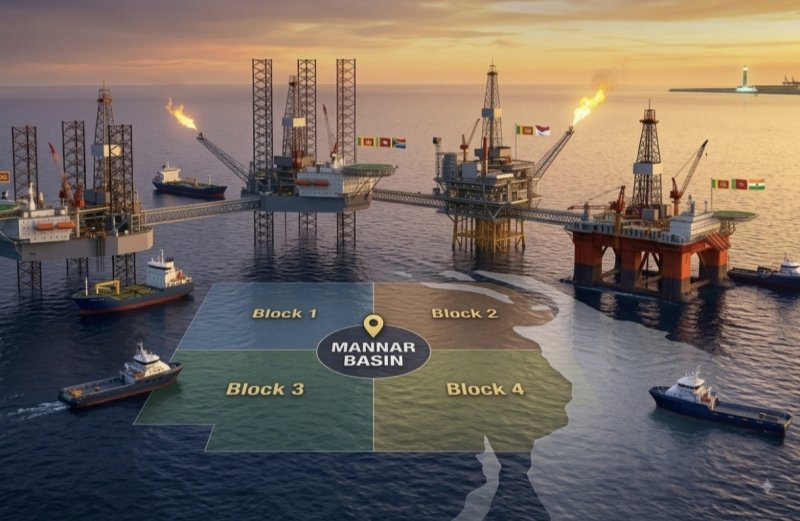
Sri Lanka is set to invite international bids for the exploration and extraction of highly anticipated oil and natural gas reserves located in the Mannar Basin.
The government plans to officially open the bidding process later this month, aiming to attract global energy companies to develop four designated offshore blocks. The estimated value of the oil and gas deposits within this region is highly lucrative, with assessments suggesting the reserves could be worth an estimated $267 billion. The Petroleum Development Authority of Sri Lanka (PDASL) serves as the national regulatory body overseeing these oil and gas exploration and production initiatives.
The pursuit of these offshore energy resources is deeply rooted in Sri Lanka's history, dating back to 1966. Between 1966 and 1984, Soviet and Western companies focused their exploration efforts on the land and shallow offshore areas of the Gulf of Mannar, which functions as the southern extension of the Bay of Bengal's Cauvery Basin. During this era, 18,000 kilometers of seismic data were recorded and seven exploratory wells were drilled; although all were considered dry wells, Soviet drilling on Mannar Island did encounter wet gas shows at varying depths. Interest was further revitalized in 2001 when the Ceylon Petroleum Corporation awarded a contract to a Norwegian company to carry out expansive 2D seismic surveys, which reinforced promising indications of significant oil and gas accumulations in the deepwater frontier of the Mannar Basin.
A major breakthrough occurred in 2011, establishing a clearer understanding of the deposits located in the basin. Following an international licensing round, Cairn India—through its wholly-owned subsidiary Cairn Lanka—successfully discovered natural gas in two exploration wells. This established Sri Lanka's first working hydrocarbon reserves in decades and effectively put the nation on the global hydrocarbon map. Despite this initial success, the subsequent monetization of these gas finds and early production negotiations faced significant delays and impediments over the following years.
Currently, Sri Lanka faces a domestic shortfall in the highly specialized technical expertise and advanced equipment required to independently conduct offshore drilling operations. Consequently, the nation has opted to reach out to the global market to fulfill its energy ambitions. By launching international tenders, the country hopes to establish robust partnerships with multinational corporations and foreign states that possess the necessary technological capabilities and capital to successfully extract these deep-sea resources.
The revitalization of this offshore exploration initiative carries immense economic and political significance. Historical claims regarding marine energy reserves date back to the administration of Sirimavo Bandaranaike, and the cause was more recently championed by former Energy Minister Udaya Gammanpila during Gotabaya Rajapaksa's presidency. Alongside the Mannar Basin, there is enduring optimism regarding potential reserves in the neighboring Cauvery Basin. Should these renewed international partnerships lead to successful commercial extraction, it would mark a transformative milestone, offering immense hope, economic relief, and a path toward self-reliance for Sri Lanka's long-struggling energy sector.