The six candidates vying to lead the United Nations stressed the importance of restoring the credibility of an organization in crisis during a restrained debate Thursday, one week before the selection process formally starts.
With the campaign struggling to generate real enthusiasm for a front-runner, the hopefuls faced nearly two hours of questions from diplomats, UN employees and civil society representatives at an event in the huge General Assembly Hall, broadcast by Bloomberg.
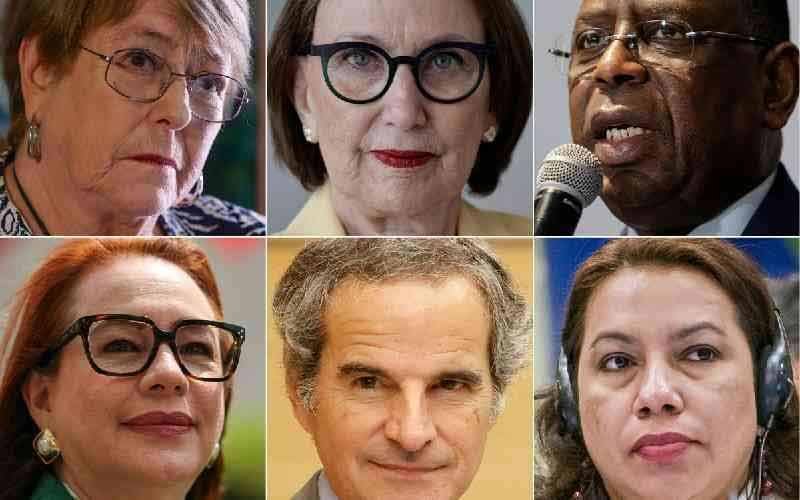
Chile's Michelle Bachelet, Ecuador's Maria Fernanda Espinosa, Rafael Grossi of Argentina, Costa Rican Rebeca Grynspan, Guyana's Carolyn Rodrigues-Birkett and Senegal's Macky Sall are all in the running to succeed outgoing Secretary-General Antonio Guterres, who leaves office December 31.
Each candidate explained why they'd be the best secretary general, highlighting strengths for confronting a particularly difficult era in global conflict, citing national or international experience and touting their ability to speak with all sides.
"Five years from now, I would like nobody to ask me again 'where is the UN?' That will be my indicator. I would like to see a UN that is back at the table on the scenarios of conflict," engendering and delivering "results on the ground," said Grynspan, who has headed the UN's Conference on Trade and Development.
Sall, a former president of Senegal, similarly vowed to use his first 100 days "to restore trust and put the UN on a path to become more agile, more effective, and more ready to listen. listen, act, and bring people together."
Like her rivals, Guyanese ambassador Rodrigues-Birkett promised to take on the UN's toughest challenges, saying "I would be that Secretary-General that would try, whether it is in Iran or in Haiti or in Sudan or in the (Democratic Republic of Congo)."
International Atomic Energy Agency head Rafael Grossi also argued for intervention in times of conflict, saying any member who triggers war or uses aggression "is serious enough for the Secretary-General to step in."
"We need to do is to restore this credibility of the UN as a valid interlocutor, and then use the tools at hand," Grossi said.
The United Nations is facing a profound financial and confidence crisis, with US President Donald Trump's administration accusing it of spending recklessly, spreading itself too thin and failing to deliver satisfactory results.
The US wants to see a return to the organization's fundamental purposes of peace and security, while other states stress the equal importance of its other two pillars: human rights and development.
No missteps
Without naming names, former Chilean president Bachelet said she would refuse to give in to pressure from powerful donor countries.
"I will speak out loud what I think is my moral authority and my duty," she said.
Former UN General Assembly president Espinosa insisted on prevention not as "a slogan but an operating principle, a discipline, and I will establish very early a prevention" to have "the UN machinery ready and active to prevent conflicts. I will be there myself, carrying the UN flag."
The candidates have already faced three hours of questioning each from representatives of the 193 UN member states.
Most stressed the need to continue the organization's ongoing reforms to make it more efficient, as well as the importance of greater involvement by the secretary-general in peace efforts around the world.
On July 30, the 15 members of the Security Council are due to hold their first closed-door, anonymous vote on their preferences among the candidates.
That first "straw poll" will be followed by an unspecified number of similar votes until one candidate can secure the required nine votes without a veto from any of the five permanent members -- the United States, Britain, China, France and Russia.
The name of the selected candidate will then be sent to the General Assembly for the formal appointment to the position. He or she will take office on January 1, 2027.
Several diplomats interviewed by AFP were cautious about the outcome of the race, saying a number of capitals had yet to make their choice.
"I find that Grossi is still the mostly frequently mentioned front-runner, but he has not locked the race up. Other candidates like Grynspan and Rodrigues-Birkett also have significant numbers of admirers," International Crisis Group analyst Richard Gowan told AFP.
Many names are still circulating in UN corridors and the media, notably that of FIFA president Gianni Infantino, whom Trump would reportedly like to see take the helm of the UN, according to the New York Post.
Under a tradition of geographic rotation that is not always followed, Latin America is making a claim to the post this time. Sall is the only candidate not from the region. Many states are also calling for a woman to hold the position for the first time.