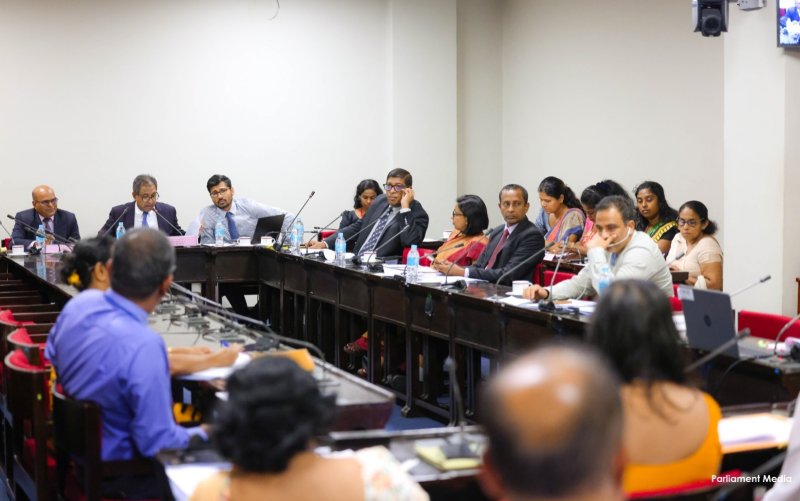
The meeting was held at the parliament premises under the chairmanship of Member of Parliament Dr. Harsha de Silva. It saw the participation of Deputy Ministers Dr. Kaushalya Ariyarathne and Nishantha Jayaweera, alongside Members of Parliament Ravi Karunanayake and Harshana Rajakaruna. MPs Wijesiri Basnayake, Attorney-at-Law Chitral Fernando, and Nimal Palihena also participated virtually via online platforms.
The committee engaged in a lengthy deliberation regarding the fundamental changes proposed to amend the Value Added Tax Act No. 14 of 2002. A key focal point of the discussion was the imposition of VAT on services provided by non-resident suppliers via digital platforms. To evaluate its impact, the committee compared two ride-sharing and transport service providers operating through online applications in the country—one locally registered and the other foreign-registered. The Chairman of the Committee pointed out that even after the tax amendment, a visible disparity remains in the amounts consumers would have to pay between locally and foreign-registered entities. Dr. de Silva expressed his concerns regarding the adverse effects this tax structure could have on Sri Lanka-based digital entrepreneurs trying to compete in the global market. In response, officials from the Ministry of Finance, Planning, and Economic Development noted that the local VAT framework for digital services aligns closely with models implemented in nations like India and the Philippines.
The committee questioned officials regarding the anticipated surge in new tax registrations after lowering the VAT threshold from Rs. 15 million per quarter to Rs. 9 million per quarter. Officials revealed that approximately 10,000 new businesses are expected to register under the new threshold. Raising concerns over how this would impact wholesale and retail shops, beauty salons, and other small businesses, the committee inquired if these small and medium enterprises (SMEs) could realistically afford the estimated Rs. 200,000 setup cost, which includes acquiring Point of Sale (POS) machines.
Committee members urged the Department of Inland Revenue and the Ministry of Finance to find supportive mechanisms to help SMEs adapt to the VAT system rather than increasing non-compliance penalties up to Rs. 1 million. Addressing this, Deputy Minister Nishantha Jayaweera noted that the government is actively considering measures to incentivize the adoption and usage of POS machines. Following a comprehensive three-hour review of the bill's core clauses, COPF granted its approval on the strict condition that once the bill is passed in Parliament, the executive regulations formulated under it must be presented to and approved by the committee before being officially gazetted.
In addition to the VAT Bill, COPF greenlit two orders published under the Special Commodity Levy Act No. 48 of 2007 aimed at regulating taxes on food imports. These included the Order in Gazette Extraordinary No. 2482/09 dated March 31, 2026, and the Order in Gazette Extraordinary No. 2487/02 dated May 04, 2026. The latter gazette intends to increase the commodity levy on imported maize from Rs. 25 to Rs. 50 per kilogram.
During the review, the committee cautioned officials to closely evaluate the broader socio-economic impact of hiking import duties on maize. Lawmakers highlighted that given the prevailing protein deficiencies in the public's diet, raising tariffs on maize—a primary component in animal feed—could drive up the prices of essential protein sources like chicken and eggs. Furthermore, the committee approved regulations published in Gazette Extraordinary No. 2487/29 dated May 07, 2026, introduced under the Import and Export (Control) Act No. 1 of 1969.