Environmental groups and small-scale fishing communities have welcomed the government’s move to ban the use of tractor winches in the traditional gillnet fishing industry, warning that mechanized operations have already caused serious ecological and livelihood damage in coastal areas.
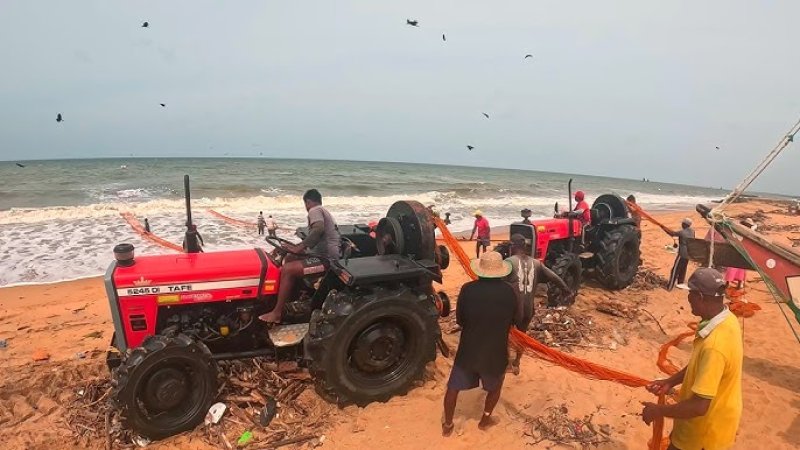
The controversy surrounds the growing mechanization of gillnet hauling — a practice historically carried out manually along Sri Lanka’s coastal belt. At present, 899 gillnets are registered across the island, with 770 in operation. Of these, an estimated 175 are now being hauled using tractor-mounted winches, a shift operators attribute to the shortage of human labor.
However, environmental advocates argue that the mechanization drive — initially allowed as a pilot project — was introduced without adequate scientific assessment and has since escalated into a major environmental concern.
Traditionally, gillnets are cast about 1.5 kilometers into the sea, but mechanized systems now enable nets to be deployed as far as 8–10 kilometers. While manual nets are typically cast twice a day, tractor-assisted operations deploy them three to four times daily, intensifying pressure on coastal fish stocks.
Stakeholders warn that the ecological impact mirrors the damage caused by bottom trawling. Reported consequences include the destruction of fish breeding grounds, capture of juvenile fish, damage to turtle nesting sites, and coastal degradation caused by tractors operating along beaches.
The practice has also contributed to fish shortages affecting nearly 37,000 small-scale fishermen engaged in shallow-sea fishing using traditional crafts such as theppam and vallam.
Environmental organizations further allege that tractor-assisted gillnet hauling violates multiple laws, including the Fisheries and Aquatic Resources Act, Coastal Conservation Act, National Environment Act, Wildlife Conservation Act, and provisions of Extraordinary Gazette No. 337/48 of February 21, 1985.
Research conducted by the National Aquatic Resources Research and Development Agency (NARA) has also identified the method as environmentally harmful.
The Centre for Environmental Justice described the government’s decision to prohibit tractor winch operations as timely and necessary, urging authorities to maintain the ban and resist any attempts to reinstate the mechanized practice.