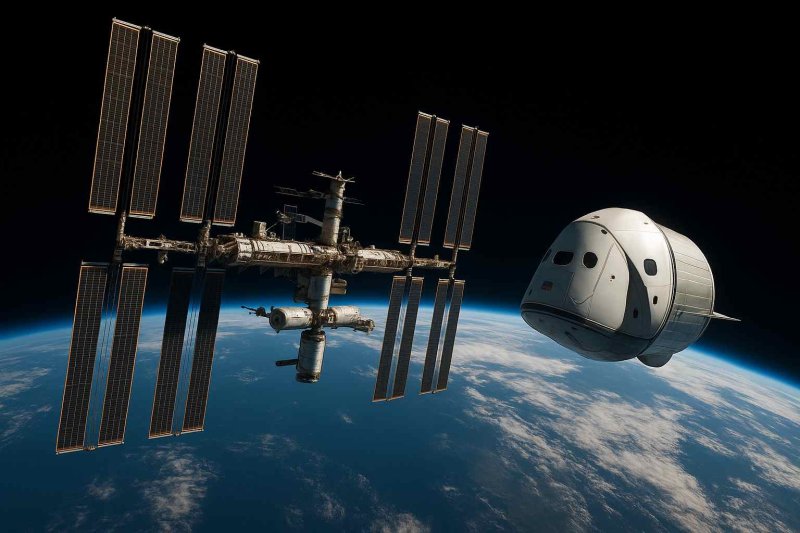
For 24 hours a day, seven days a week since November 2000, NASA and its international partners have sustained a continuous human presence in low-Earth orbit, including at least one American – a streak that will soon reach 25 years.
When viewed in the history of spaceflight, the International Space Station is perhaps one of humanity’s most amazing accomplishments, a shining example of cooperation in space among the United States, Europe, Canada, Japan and Russia. But all good things must come to an end.
2030, the International Space Station will be deorbited: driven into a remote area of the Pacific Ocean.
I’m an aerospace engineer who has helped build a range of hardware and experiments for the ISS. As a member of the spaceflight community for over 30 years and a 17-year member of the NASA community, it will be hard for me to see the ISS come to an end.
Since the first pieces of the International Space Station were launched in 1998, the station has been home to significant research accomplishments across domains that include materials science, biotechnology, astronomy and astrophysics, Earth science, combustion and more.
Astronauts performing research inside the space station and payload experiments attached to the station’s exterior have generated many publications in peer-reviewed science journals. Some of them have advanced our understanding of thunderstorms, led to improvements in the crystallization processes of key cancer-fighting drugs, detailed how to grow artificial retinas in space, explored the processing of ultrapure optical fibers and explained how to sequence DNA in orbit