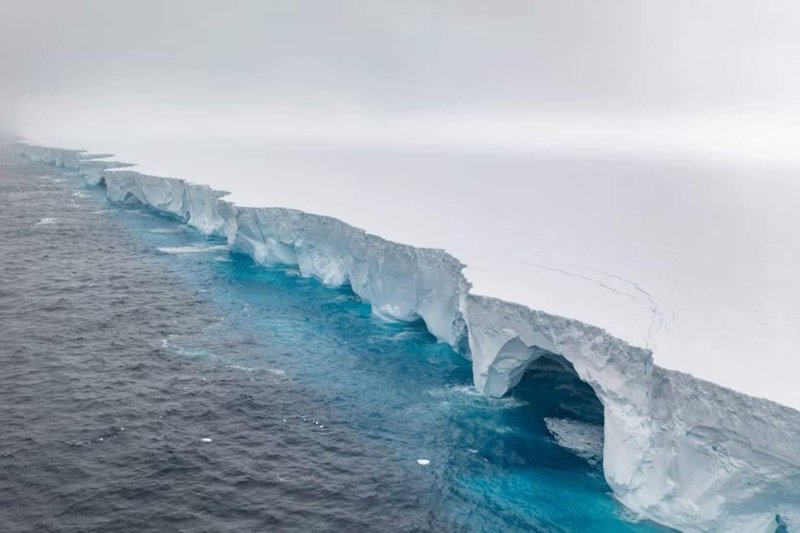
The slow fade of one of the world’s oldest icebergs is a stark reminder of the changes happening in our climate. A colossal iceberg, known as A23a, is breaking apart and melting faster than ever as it drifts through warming seas. Its dramatic transformation offers a rare glimpse into how global warming affects Earth’s frozen frontiers.
According to LeRavi A23a has a unique story that dates back to 1986, when it calved off from a massive ice shelf in the Weddell Sea, near Antarctica. This iceberg, made entirely of frozen freshwater, initially covered an astonishing 1,544 square miles — roughly the size of Rhode Island. For decades, it remained anchored to the ocean floor, seemingly immovable.
But in 2023, after more than 35 years of stability, the iceberg broke free. Scientists call this a rare event because few icebergs this large ever move into warmer waters. It’s like watching a gargantuan ice cube slowly lose its grip in a glass of warm water.
Bert Wouters, a geosciences expert at TU Delft, described it as a “natural experiment” that reveals what the future might hold as our planet heats up. Watching A23a’s journey is a front-row seat to climate change in action.
Recent reports from The Guardian detail a rapidly changing scene. Huge chunks of the iceberg have been breaking off over the last few weeks. According to AFP, A23a has already shrunk by half of its original size. Its current dimensions stand at about 684 square miles in area and roughly 23 square miles in width.
What’s even more surprising is the iceberg’s pace. Satellite images show that it’s moving northward at a brisk clip — sometimes covering up to 12 miles per day. For a massive chunk of ice, that’s an impressive sprint.
Andrew Meijers, a physical oceanographer, explained the iceberg is literally “rotting from underneath.” Warm ocean water is relentlessly chipping away at the ice, causing it to melt continuously. It’s not just breaking; it’s dissolving in the warmer seas.
The longevity of A23a was impressive in a time of rapid climate shifts. But its decline is also a signal. Scientists observe that with rising global temperatures, Antarctic ice shelves are breaking off more frequently and melting faster than before.
Watching this firsthand brings climate change into sharp focus. I recall visiting the Alps some years back, greeted by alarmingly retreating glaciers. The Morteratsch Glacier in Switzerland, for instance, was visibly shrinking, a sign mirrored by the changing ice landscapes in the Southern Hemisphere.
Such experiences make abstract statistics real. They remind us that these aren’t distant problems but urgent, tangible shifts happening now.